Have you ever bought a book, put it to the side for a long time, and just so happen to pick it up at the right moment in your life?
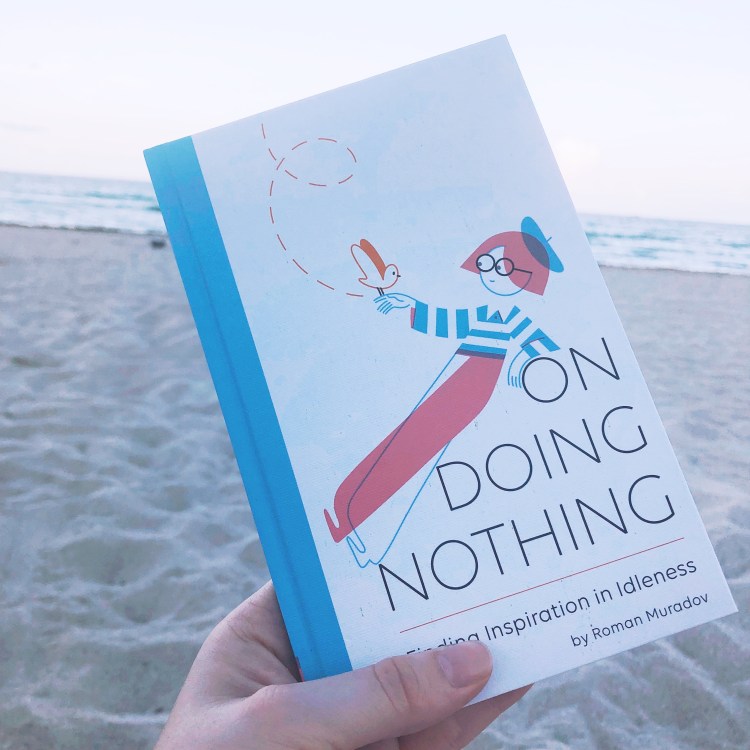
Roman Muradov’s On Doing Nothing is — to quote the intro — “not a book about not doing anything; it’s a book about doing nothing.” I bought it in a super cute local feminist shop during a short trip to Miami last summer… and put on the bookshelf when I got home and forgot about it.
When I was working my way through my unread books during quarantine, I hit a point where I wanted something small, an easy book to conquer and this one was waiting for me.
What I wasn’t entirely expecting was to get an exploration of what we do — and what we can do — during life’s quiet moments. On Doing Nothing is, at its core, a book about the creative process and how calm, quiet moments can be just as productive as intense brainstorming or work sessions.
Through a calming writing style and an abundance of literary and pop culture references, Muradov advocates for not just consuming content and engaging with it, but letting it sit with you for a while, thinking about it in a personal way and analyzing how it speaks to you and inspires you in small ways.
It’s a short book, 104 pages, which makes an easy book to read in an afternoon or split between a couple afternoons. In total, it took me a little over two hours to read over two days. A super chill weekend read or an easy slump buster.
Muradov’s writing style is charming in a way that made me want to dog ear pages and underline the text. The scattered minimalist illustrations add to the aesthetic of the writing style and make the sometimes research-style text seem more casual.
If you want a feel for a vibe of this book, here are a couple of quotes that resonated with me:
“To get lost on purpose is to abandon all purpose… To get lost in the conventional sense is to fail in finding the predetermined destination; to lose oneself is to set off without a destination, to see the map and the terrain as the primary points of interest”
“We can barely pass along the simplest bit of news without adding to it our own interpretation, or, in other words, rewriting it. The network of fiction surrounding our daily conversations extends beyond the scope of any library.”
“When we blur the lines between life and art, both can be a little more enjoyable.”
Some of the longer sections did not always hold my attention and I felt some paragraphs went on a little long. But ironically, when I zoned out during paragraphs, I often found myself thinking about creative projects I have in progress, or considering more deeply a paragraph from earlier in the book. So I might have missed one small point or two Muradov wanted to make, but probably proved his overall thesis.
Some of the references went over my head by a hair (sometimes more), but if you’re up to date on your mildly obscure literary references or you just like that kind of thing like I do, then this is the book for you.
You might also enjoy this book if you’re…
- Looking for a quick read to ease your mind about all the “wasted” time you’ve spent during these strange times
- Looking for a counterargument to our modern culture’s insistence that if you’re not working on something at all times, you’re failing at life
- Looking for a good discussion about potentially why the creation and consumption of fanworks appeal to people
- Looking for a calm, easy read about creativity with adorable illustrations
Final rating: 4/5 stars
Genre: Nonfiction
Want to share this post on Pinterest? Use this image below and follow me @serenaspeaking on both Pinterest and Instagram!
 serenaspeaking.com